Free delivery on orders over €50
Free delivery on orders over €50

> On resellers
Available exclusively at our participating opticians

UV rays everywhere, we see this term all over the media, on our sunscreen bottles and even on our clothes… but who are they really, and most importantly, what are their dangers?
First of all, we’re going to start with a little scientific explanation (I promise it won’t last long!). Alright, let’s go back to our high school Physics lessons and pay attention! ????
As a reminder, it was our dear Newton who discovered the light spectrum (Well, he didn’t just get hit by an apple for nothing!). The analysis of light consists of creating its spectrum through the phenomenon of dispersion, which allows us to observe the different radiations that make it up.
Each light radiation is associated with a wavelength (λ). Those between 400 nm and 800 nm are visible to the human eye.
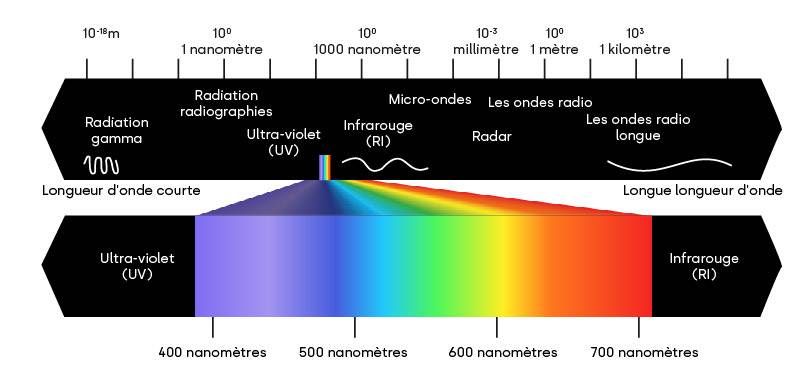
As you can see, ultraviolet rays are part of the invisible spectrum, just like infrared rays and many others.
But why are UV rays not visible to our eyes?
In fact, they have a wavelength that is too short to be visible to the human eye. But a shorter wavelength means much higher energy, making them even more harmful to the human body, especially to our eyesight.
However, rays with a longer wavelength are generally more numerous and can be more penetrating.
Warning, they are not visible but our eyes can still be affected by them!
Ultraviolet rays are classified into 3 categories depending on their wavelength, which can range between 100 nm and 400 nm. They are divided into UVA, UVB and UVC rays. Thanks to the absorption of UV rays by the ozone layer, almost 95% of the rays that reach the Earth’s surface belong to category A.
You should not confuse the feeling of heat caused by the Sun with UV rays — this is mainly caused by infrared rays. Even when the weather is cold and cloudy, ultraviolet rays still pass through the atmosphere.
Good to know:
UVA rays are the closest to visible light. As mentioned above, they represent 95% of the UV radiation that reaches the Earth’s surface. With their long wavelength, they are not extremely energetic but are highly penetrating. They can pass through glass and penetrate the skin down to the dermis, so imagine what they can do to your eyes!
UVA rays pass through the upper layers of your eyes and reach the lens. The cornea can still block 99% of these ultraviolet rays (Nature really does things well!), but the retina remains exposed to 1%, which can have serious long-term consequences for your eyes. Excessive absorption could cause keratitis or even cataracts.
Good to know:
UVB rays have a medium wavelength and only penetrate the surface layers of the skin. Yes, they are the ones responsible for your sunburns! (Yes, we have all fallen asleep on our towel between two swims ????).
If you do not wear sunglasses, UVB rays reach the cornea, which can filter them but becomes damaged little by little. Excessive exposure to UVB rays can cause inflammation of the cornea.
This type of ultraviolet ray is the most harmful, but fortunately the ozone layer still manages to filter them all. However, they can still be found on Earth through specific lamps used in biological laboratories.
As you can see, it is really important to be careful when choosing your sunglasses. Here are a few rules to follow:
There you go, we hope we have helped you better understand these famous UV rays that everyone talks about. And don’t hesitate to ask us any questions in the comments!
Panda theme is a modern, clean and professional Prestashop theme, it comes with a lot of useful features. Panda theme is fully responsive, it looks stunning on all types of screens and devices.

Panda theme is a modern, clean and professional Prestashop theme, it comes with a lot of useful features. Panda theme is fully responsive, it looks stunning on all types of screens and devices.

Panda theme is a modern, clean and professional Prestashop theme, it comes with a lot of useful features. Panda theme is fully responsive, it looks stunning on all types of screens and devices.
Panda theme is a modern, clean and professional Prestashop theme, it comes with a lot of useful features. Panda theme is fully responsive, it looks stunning on all types of screens and devices.
Panda theme is a modern, clean and professional Prestashop theme, it comes with a lot of useful features. Panda theme is fully responsive, it looks stunning on all types of screens and devices.
Panda theme is a modern, clean and professional Prestashop theme, it comes with a lot of useful features. Panda theme is fully responsive, it looks stunning on all types of screens and devices.
Panda theme is a modern, clean and professional Prestashop theme, it comes with a lot of useful features. Panda theme is fully responsive, it looks stunning on all types of screens and devices.
Panda theme is a modern, clean and professional Prestashop theme, it comes with a lot of useful features. Panda theme is fully responsive, it looks stunning on all types of screens and devices.
Panda theme is a modern, clean and professional Prestashop theme, it comes with a lot of useful features. Panda theme is fully responsive, it looks stunning on all types of screens and devices.
Panda theme is a modern, clean and professional Prestashop theme, it comes with a lot of useful features. Panda theme is fully responsive, it looks stunning on all types of screens and devices.
Panda theme is a modern, clean and professional Prestashop theme, it comes with a lot of useful features. Panda theme is fully responsive, it looks stunning on all types of screens and devices.
Panda theme is a modern, clean and professional Prestashop theme, it comes with a lot of useful features. Panda theme is fully responsive, it looks stunning on all types of screens and devices.
Panda theme is a modern, clean and professional Prestashop theme, it comes with a lot of useful features. Panda theme is fully responsive, it looks stunning on all types of screens and devices.
Panda theme is a modern, clean and professional Prestashop theme, it comes with a lot of useful features. Panda theme is fully responsive, it looks stunning on all types of screens and devices.
Panda theme is a modern, clean and professional Prestashop theme, it comes with a lot of useful features. Panda theme is fully responsive, it looks stunning on all types of screens and devices.
Panda theme is a modern, clean and professional Prestashop theme, it comes with a lot of useful features. Panda theme is fully responsive, it looks stunning on all types of screens and devices.
Panda theme is a modern, clean and professional Prestashop theme, it comes with a lot of useful features. Panda theme is fully responsive, it looks stunning on all types of screens and devices.
Panda theme is a modern, clean and professional Prestashop theme, it comes with a lot of useful features. Panda theme is fully responsive, it looks stunning on all types of screens and devices.
Panda theme is a modern, clean and professional Prestashop theme, it comes with a lot of useful features. Panda theme is fully responsive, it looks stunning on all types of screens and devices.
> On resellers
Available exclusively at our participating opticians
Please sign in first.
Sign in
Create a free account to save loved items.
Sign in Replacement lenses
 Adult Interchangeables arms
  Pounchs & microfibers